
TL;DR:
- Effective copywriting can boost conversions by up to 200%, outperforming design and technical changes significantly. Using real customer language, outcome-focused headlines, and structured proof are proven techniques that magnify persuasive impact. Prioritizing strategic copy improvements over aesthetic adjustments unlocks the largest, most cost-effective growth opportunities.
Most businesses chase conversion rate improvements through redesigns, faster load times, and button colour tests. These changes matter, but they are rarely where the largest gains hide. The real role of copywriting in conversion is consistently underestimated, even by experienced marketers. Copy-driven elements like headlines and calls to action produce conversion lifts of 50 to 200 percent, while design and technical changes typically deliver just 2 to 20 percent. This article covers the evidence, the techniques, and the practical frameworks you need to make copywriting your most powerful growth lever.
Table of Contents
- Key takeaways
- What is conversion copywriting and why does it matter?
- Evidence-based impact of copywriting on conversions
- Core copywriting techniques that drive conversions
- Applying copy at different funnel stages
- Common pitfalls in conversion copywriting
- My honest take on copy as a conversion lever
- How Nulifedigital can help you convert more
- FAQ
Key takeaways
| Point | Details |
|---|---|
| Copy outperforms design | Headlines, CTAs, and value propositions drive 50–200% conversion lifts versus 2–20% from design changes. |
| Voice-of-customer language wins | Using real customer phrases in copy consistently outperforms marketer-written versions in conversion tests. |
| Persuasion architecture matters | Rearranging headlines, proof, and objection handling as a system produces larger gains than isolated edits. |
| Context shapes every word | Copy must match the funnel stage, traffic source, and customer mindset to perform at its best. |
| Measure conversions, not engagement | Time on page and shares are vanity metrics. Only downstream actions like purchases confirm that copy is working. |
What is conversion copywriting and why does it matter?
Conversion copywriting is writing with a single purpose: to move a reader toward a specific action. That action might be making a purchase, booking a call, filling in a form, or signing up for a trial. It is distinct from brand copywriting, which builds awareness and tone, and from content writing, which educates and informs over time. Conversion copy exists at the moment of decision.
The components that make it work include:
- Headlines that immediately communicate a clear and relevant benefit, creating enough pull to stop a visitor from leaving
- Value propositions that explain precisely why your offer is the right choice for this specific audience at this specific moment
- Calls to action that are specific, outcome-focused, and aligned with where the reader is in their decision process
- Social proof structured to remove doubt, whether through testimonials, case studies, statistics, or named endorsements
- Objection handling that anticipates hesitation and addresses it before the reader has a chance to act on it
The persuasion frameworks underpinning effective conversion copy are not new. Cialdini’s principles of reciprocity, commitment, social proof, authority, liking, and scarcity remain as relevant as ever. What has changed is the precision with which skilled copywriters deploy them. Conversion copy does not rely on pressure or manipulation. It works by reducing uncertainty and increasing confidence at exactly the right moment.
The importance of persuasive writing in sales becomes most apparent when you realise that your website or landing page cannot have a conversation. The copy is the sales conversation, in written form, and if it does not handle objections, build trust, and make the value obvious, no amount of visual polish will compensate.
Evidence-based impact of copywriting on conversions
The data on copy versus design is stark. Design and technical improvements such as page speed fixes, layout restructures, or button colour changes consistently produce modest lifts. Copy changes to the same pages routinely outperform them by a factor of five or more.
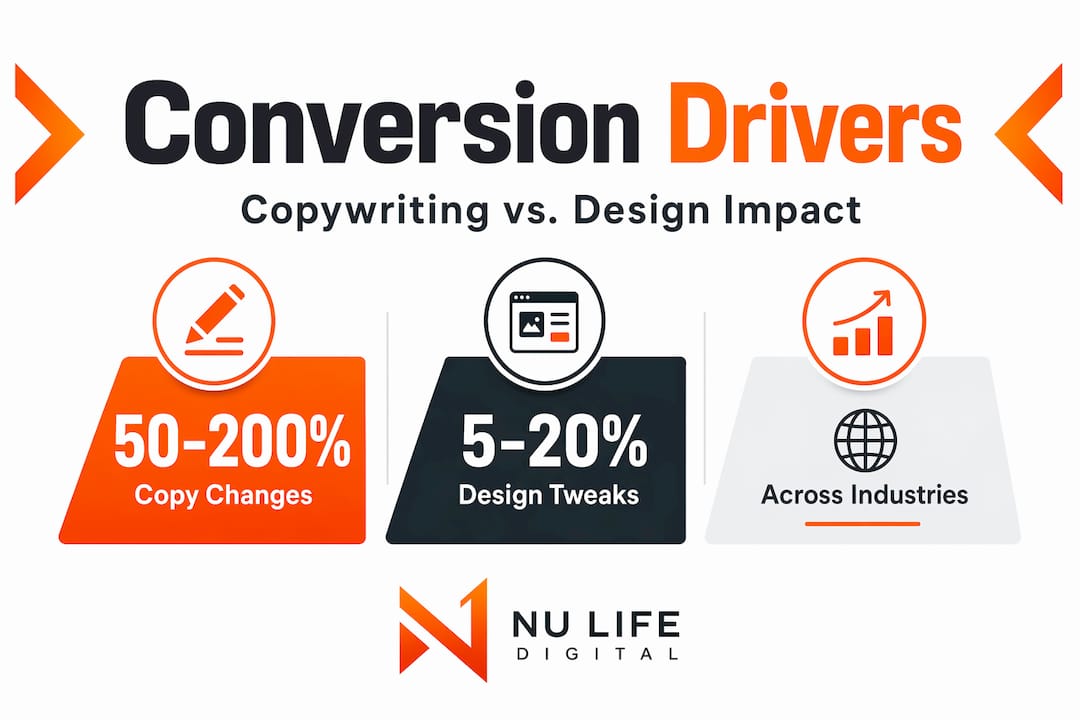
Consider what happens when copy changes are applied to e-commerce product pages. Product title, description, and CTA rewrites without any technical changes regularly produce conversion lifts of 20 to 100 percent or more, simply because they address buyer psychology more directly.
One case study illustrates this particularly well. A sales page headline rewrite, shifting from a feature-led statement to an outcome-focused message, increased conversions from 1.8% to 4.7%. That is a 161 percent lift. The financial result was an additional £38,000 in monthly revenue. The design did not change. The traffic did not change. The offer did not change. Only the words changed.
“Outcome-focused messaging shifts outperformed design changes, driving nearly triple the original conversion rate.” — CRO case study findings
| Change type | Typical conversion lift |
|---|---|
| Copy: headlines, CTAs, value propositions | 50–200%+ |
| Design: layout, colour, imagery | 5–20% |
| Technical: speed, mobile optimisation | 2–10% |
| Personalisation: dynamic content | 10–30% |
The pattern is consistent across industries and page types. For marketing professionals and business owners, this has a direct implication: if your CRO budget and attention are weighted toward design, you are probably leaving the majority of your potential gains on the table.
Core copywriting techniques that drive conversions
Understanding the impact of copywriting on sales is one thing. Knowing which techniques to apply is another. Below are the methods with the strongest evidence base.
-
Mine voice-of-customer language. Read your reviews, your support tickets, your sales call recordings. The phrases your customers use to describe their problem and their desired outcome are more persuasive than anything a marketer invents. Voice-of-customer language consistently outperforms marketer-written copy in head-to-head tests because it resonates at a recognition level rather than a rational one.
-
Write headlines that state the outcome, not the feature. “Lose 5kg in 8 weeks without cutting carbs” outperforms “Our science-backed nutrition programme” every time. The reader’s brain is always asking “what’s in it for me?” and your headline must answer that within two seconds.
-
Replace generic CTAs with specific, value-oriented language. Specific CTAs aligned with clear value compel far more action than commands like “Submit” or “Click here.” “Get my free audit” or “Start saving time today” both tell the reader exactly what they are getting, which reduces friction and increases clicks significantly.
-
Build proof sections with structure and specificity. A single testimonial that says “Great product!” adds almost nothing. A testimonial that names the problem, describes the experience, and states a specific result adds considerable trust. Structure your proof so it mirrors the objections your readers are most likely to have.
-
Address objections before they form. Think about the three or four most common reasons a qualified prospect does not convert, and answer them in the copy before the reader reaches for the back button. Risk reversals such as guarantees, clear returns policies, and transparent pricing all belong here.
-
Combine attitude and behavioural claims in persuasive messaging. Experimental research on persuasive communication involving over 1,500 participants found that messages combining both attitude-based and behaviour-focused claims outperform either approach used alone. Copy that says “Thousands of marketers trust this tool” and “Start your first campaign in under 10 minutes” works harder than either statement independently.
Pro Tip: Before writing a single word of copy, complete a voice-of-customer audit. Pull fifty real customer reviews and highlight the specific phrases used to describe the problem and the outcome. Use those exact phrases in your headlines and value propositions. You will almost always outperform copy written without this research.
Applying copy at different funnel stages
Effective copywriting strategies change depending on where a visitor sits in their decision process. Copy that works brilliantly for a cold traffic landing page will often underperform on a retargeting page, because the two audiences have completely different levels of awareness and trust.

Landing page copy performs best when it serves a single conversion goal, presents benefits rather than features, uses social proof to remove hesitation, and addresses risk through reversals and trust signals. Scannability is critical. Most visitors skim before they read, so your headline, subheadings, and bullet points must tell the whole story independently of the body text.
For e-commerce product pages, the highest-impact changes tend to be:
- Rewriting product titles to include the primary customer benefit, not just the product name
- Replacing specification-heavy descriptions with benefit-led copy that answers “why does this matter to me?”
- Adding objection-handling copy below the fold, covering common hesitations around delivery, quality, and returns
- Testing specific, outcome-focused add-to-cart button copy rather than defaulting to the platform default
Email CTAs deserve particular attention. Matching CTA language to the specific value promised in the email body, rather than using a generic button, is one of the simplest and most underused improvements available to most marketing teams.
Pro Tip: Map your copy to your traffic source. A visitor arriving from a branded search already trusts you and needs less persuasion architecture. A visitor from a cold social ad has no prior relationship and needs more proof, more reassurance, and a lower-commitment first step. The same copy cannot serve both well.
Copy performance also depends on matching tone and depth to the customer’s context and funnel stage. A high-involvement B2B purchase needs detailed, evidence-heavy copy. A low-cost impulse buy needs brevity and urgency. Getting this wrong costs conversions regardless of how well-written the individual sentences are.
Common pitfalls in conversion copywriting
Even experienced marketers fall into patterns that limit the effectiveness of their copy. The most damaging ones are worth naming directly.
- Prioritising design tests over copy tests. Many teams spend months testing button colours and image placements while the core message remains unchanged. Most conversion gains come from copy improvements, not visual adjustments. If your testing roadmap is design-heavy, reconsider the sequencing.
- Writing in marketer language rather than customer language. Terms like “end-to-end solution,” “best-in-class performance,” and “synergistic approach” mean nothing to a buyer. They signal that the writer is thinking about the product rather than the person reading.
- Measuring success through engagement rather than conversion. Tracking downstream actions like purchases and form completions is what actually tells you whether copy is working. Time on page, scroll depth, and social shares are interesting but they do not pay the bills.
- Making minor tweaks instead of structural changes. Changing a single word in a headline rarely produces significant results. Rearranging persuasion architecture as a system, that is, overhauling headlines, value propositions, proof, and objection handling together, is where the substantial lifts come from.
- Ignoring funnel stage context. Copy written without consideration of where the reader is in their journey almost always underperforms. A first-time visitor needs reassurance and clarity. A returning visitor who abandoned a checkout needs a reason to trust and a reduced barrier to complete.
My honest take on copy as a conversion lever
I have worked with enough businesses to say this with confidence: copy changes consistently outperform every other CRO intervention I have seen. Not sometimes. Consistently.
The challenge is not that marketers do not understand this intellectually. It is that deep copy reform requires conviction and time that most teams do not commit to. It is far easier to approve a redesign than to facilitate a proper voice-of-customer research process, challenge the existing messaging architecture, and write and test genuinely different copy.
What I have seen transform client results is not a single clever headline. It is the decision to treat the entire page as a persuasion system and to audit every element through the lens of “does this reduce doubt and increase confidence?” That shift in thinking is what separates businesses that get incremental gains from those that see step-change improvements.
My advice for marketing professionals balancing copy against other CRO variables: do your design and technical work, but sequence your copy improvements first. A fast, beautiful website with weak copy will always underperform a slower, simpler one with copy that speaks directly to what your buyer actually wants to hear. Get the words right, then optimise everything around them.
— Ryan
How Nulifedigital can help you convert more
If this article has clarified one thing, it is that conversion gains do not live in your page speed scores. They live in your words. At Nulifedigital, we build pages and systems where copy and structure work together to turn visitors into buyers. Every landing page, product page, and campaign we produce is engineered around persuasion architecture, not just aesthetics.
Whether you are an e-commerce brand trying to scale past your current revenue ceiling or a service business looking to generate more qualified enquiries, we can help you find and fix the copy gaps that are costing you conversions. Explore our e-commerce conversion strategies for a practical breakdown of what actually moves the needle, or review our website conversion optimisation tips to see how copy and design work together across a full site. When you are ready to move beyond theory, we are ready to build.
FAQ
What is the role of copywriting in conversion?
Copywriting drives conversions by reducing doubt, communicating value, and prompting action at the moment of decision. Copy-driven changes to headlines, CTAs, and value propositions typically produce 50 to 200 percent conversion lifts, far outperforming design or technical changes alone.
How does copywriting influence conversions on landing pages?
Landing page copy improves conversions by clarifying the offer, addressing objections, and guiding visitors toward a single action through benefit-led headlines, structured proof, and specific CTAs. Effective landing page copy also matches the tone and detail level to the visitor’s awareness stage and traffic source.
What are the most effective copywriting techniques for conversion?
The highest-impact techniques include using voice-of-customer language, writing outcome-focused headlines, replacing generic CTAs with specific value-oriented alternatives, and building structured proof sections that mirror common objections. Treating the page as a persuasion system rather than editing individual sentences produces the largest gains.
Does copywriting matter more than design for conversions?
Yes, consistently. Design improvements typically yield 5 to 20 percent conversion lifts, while copy changes to the same pages produce 50 to 200 percent or more. One headline rewrite case study produced a 161 percent lift and added £38,000 in monthly revenue without any design changes.
How do I know if my conversion copy is actually working?
Measure actual conversion events, not engagement metrics. Tracking downstream actions such as purchases, form completions, and bookings tells you whether copy is persuading. Time on page and scroll depth are useful diagnostics but they do not confirm that copy is driving the behaviour you need.
Recommended
- How content drives conversion rates: key strategies 2026 – Nu Life Digital
- Effective conversion tactics: proven examples to boost sales – Nu Life Digital
- Website conversion workflow that drives measurable growth – Nu Life Digital
- How to build high converting pages for lasting growth – Nu Life Digital